Book Take-Aways and a Google Privacy Policy #FAIL

Today I learned:

1. Take-aways: I was reading the materials provided for an upcoming leadership training program I am participating in and one of the stats given was intriguing: Only 1% of people who read a business book will actually implement any of the ideas.

There was no source provided so I can’t back this up (and for this reason I am not citing where I read it), but it does seem like a reasonable guesstimate.  It got me thinking. Am I part of the 99%…or the 1%?

It seems in this area I am not doing too bad, but I could be doing better. When I read I already do it pen in hand and I am forever circling, underlining and bending page corners to keep note of things that hit home for me.  That said, I rarely look back to recalibrate on the lessons learned. Tonight I decided to change that with a new strategy.

Whenever I finish a book, if I think there are things I need to implement, I am going to schedule a 30 minute reflection in my calendar about a month away to revisit it.  If I find that time helpful I will schedule another one a bit further down the road.

To experiment, I tried it tonight with Peter Legge’s The Power of a Dream which I finished in the fall of 2011. It turns out there were several lessons and anecdotes I have actually used, but the refresher reminded me of a few gems I had forgotten.  A worthy exercise it seems. My assumption is that with a powerful book after 2-3 reviews I should be able to ingrain the key points permanently. Will it take more? Maybe, but this plan is a start, and it seems a useful experiment. Why not invest another couple hours or so in a book you feel strongly about? Otherwise it just gathers dust.

I am interested to know if anyone else does something similar – any comments?

2. Google Age Restrictions? Privacy Policy #Fail: Google products are integrated deeply into my life and the way things are going I assume they will be weaved into the lives of my kids too. That’s why I am quite concerned with a piece of their new privacy policy.  I was reading up on the changes tonight and I found this link outlining a new age requirement of 13 years for a Google Account in Canada.

Presumably this was done to match the existing Google+ age-restriction policy, but I see a problem with it.

Gmail is email. It is not Google+, and not Facebook. It is social, but not a social network. Integrating all our accounts across platforms makes some sense, but not when it limits access to the most basic communication tool they have – email. That’s akin to telling me when I was growing up in the 1980’s that I wasn’t allowed to buy stamps.

This could actually create a problem for me – I already have accounts for my kids. In fact, they had them in the womb. They are not even close to 13, and while the kids don’t even know about them yet, my wife and I actually use them. We send them things like pictures and funny one liners as sort of e-diary which we hope they will one day enjoy reading.

Will we let the kids use the accounts prior to age 13?  That was certainly the plan.  From what I understand lots of local kids need email as early as grade 1 to manage homework and communicate with their teacher.  I would hate to think this policy could sent my kids flocking to Hotmail, or god forbid, Yahoo.

Is the Messenger killing us? Plus, Anchoring your Calendar

Today I learned:

1. The Messenger might be killing us: I was watching the news last night and eventually just had to turn it off.  I get it. The world sucks. It’s a dangerous place.

Or is it?

Watching another round of updates on the calamity in the world made me wonder why we see so few stories about the good things in life. With a bit of exploring, today I learned Karl Aquino from the Sauder School of Business at UBC – where I completed my MBA – completed some research on this and found that instead of freaking us all out the media could actually make the world a better place just by reporting good news.

The funny thing is that this is intuitive.  The Power of Positive Thinking. The Secret. The Leader Who Had No Title. All books that in one way or another subscribe to the general idea you can be a better person, and lead a more fulfilling life just by filling your mind with positive thoughts and adopting an optimistic, forward-looking perspective. It is not a stretch then to suggest that if we were all working together, helping fill each others minds with positive thoughts, then we might all be better off.  The media could certainly help with an initiative like that.

Yes, I know. I am living in a dream world.

Feel good stories don’t sell.

Or do they?

Imagine an hour of news without drugs, murder, accidents or the nightly Hollywood train wreck.  An hour where Mike McCardell gets the lead.  That’s an hour I would look forward too.  That would have also kept me tuned in last night, lending a couple more eyeballs to the commercials that are funding the broadcast.

2. Anchoring: One more lesson from The Monk Who Sold His Ferrari by Robin Sharma. (I am finished the book now, so I promise I will stop!)

A new addition to my weekly calendar: Anchoring. As in taking the time to “anchor” into my week the most important things in life – kids, family, personal and physical development, fun – the things that don’t get booked and that we assume will occur spontaneously or we will just fit in.

The concept works for me, because I spent the 28 months of my part-time MBA  program meticulously scheduling every moment of my day, just to fit everything in. I have gotten away from it recently, only really scheduling personal activities that seemed important like haircuts, doctor visits, and days off . A subtle shift in what I deem as important, and therefore what I book into my week, should make this new activity helpful and in turn make the behaviour stick.

Working from home and I forgot about Facebook

Today I learned:

1. Best Practices for the home office: With knee surgery in a few weeks I am going to be unable to drive and limited in my walking tolerance for a couple weeks so I will be forced to work from home for a short period of time until I am fit enough to make the trek into work.  Critically, my recovery period coincides with a particulaly busy period in a large project with a vendor, so I will need to be efficient in the time I put in from home.

In preparing for a period of work out of the office, I was inspired today to read up on best practices for working from home. A few great sources (Lifehacker, ZenHabits, Productivity501, and Stepcase Lifehack) have helped me prepare.

My key take-aways are:

  • Prepare for the day: The goal after surgery is to resume normal activities of daily living as quickly as possible, so this fits right in. Get up, shower and get dressed. Do everything I would normally do, just skip the commute and go straight to work.
  • Stay-connected: Pre-book calls and video chats for updates with both superiors and reports at the bookends of the day to help me stay connected and on task with deliverables.
  • Take breaks: Schedule down-time to help keep the energy up. I’ll need to be in a regular routine of physio exercises and icing anyway, so building in recovery time is critical.
  • Get the right tools: I have pre-tested all the required technology (laptop, VOIP phone, remote desktop) so there should be no surprises.
  • Shut the door: Make a clean break between work and personal life, particularly when the kids are home, to make sure I remain effective in both areas.

Any other tips to keep me on track?

2. I forgot about Facebook:  A pleasant by-product of my committment to learn two things a day (and to blog about it for the first 66 days straight) has been a noticeable change in my consumption patterns on the web, specifically with respect to Social Media.

The bottom-line?

I just went a week without accessing Facebook, and until today I didn’t even notice.

I think I have subtly shifted from passive to active consumption. Over the last few weeks my media consumption has moved towards sources of inspiration, rather than simply connection. With a committment to blog two personal take-aways from every day, I have spent more time reading books, magazines, blogs, and simply trying to talk to people.

At the same time I have watched less TV, changed the sites I visit online and, interestingly, without even noticing at first I have stopped checking my stream on Facebook.  I always knew I was a big Facebook lurker and I was really just using it to kill time.  Now that I am tasked with trying to produce something creative – even something on a very small scale – on a daily basis, I have almost no use for it.

It is certainly an interesting by product of this little experiment, and may just be my favourite lesson so far.

Steve Jobs was an A–hole and Robin Sharma is a Genius

I can’t seem to read just one book at a time. Typically I have a few going and I switch back and forth depending on my mood. On the nightstand right now is the Steve Jobs biography by Walter Isaacson, and The Monk Who Sold his Ferrari by Robin Sharma.

From these two amazing books, today I learned:

1. Steve Jobs was an A–hole (and a Genius): From the sounds of it the only thing you could predict about Steve Jobs was that an encounter with him would be entirely unpredictable.

A terrible boss. Demanding, demeaning, insanely detail focussed. I doubt I could have worked for him but I wish I could have.

A terrible customer. He would never hestitate to explain everything you had done wrong. There was no filter. No mute button. I would have hated dealing with him, but I wish I could have.

A terrible listener. Prepared slides be damned. No way would he sit quietly through your presentation. It would have been impossible to present to the man, but I would have loved to have tried.

An utter genius with an unrelenting drive for perfection. I own 6 products with his stamp on them. I can’t imagine life without them – they make my day easier and remarkably more fun. The more I learn about the man the more I find to both like and dislike, and the more I want to buy his stuff.

2. Robin Sharma is a genius:  I just picked up a copy of The Monk Who Sold his Ferrari, and only a few pages in I am fascinated. I already considered one of his other books, The Leader Who Had No Title, the most simple and simultaneously profound book I have ever read, so it is no surprise I am enthralled with this one too.

As a carryover from school I always read with pen in hand ready to circle things that impact me. This is the passage that hit me today:

What I love about Robin Sharma is the simplicity at the core of everything he writes. Stripped down messages not unlike Aesop’s fables. This passage presents such a simple concept in a way that is easy to action. After today I know that the next time I am presented with an idea I will be sure to ask myself, “Is my cup full or empty?”

The Marginal Cost of Email and Price discrimination at the Parking Meter

Today I learned:

1. The marginal cost of an email is not always zero: Witty banter back and forth via email is a lot less fun when it’s a lawyer on the other end of the exchange and you know she bills you $20 every time she reads one of your messages.

This made me wonder, if I knew I was going to be invoiced $20 every time a recipient read one of my messages, how many emails would I actually send?

I am guessing a lot fewer.

So, should I build that into my decision-making criteria when determining whether or not to use email for certain types of communication?

I am guessing I should.

2. Perfect Price Discrimination for…Parking? The headline in today’s Vancouver Sun reads “Vancouver Parking rates could vary by block, month with new project.” Apparently 1500 of the city’s 10,000 meters can now have rates remotely changed.

The issue?  Not enough people are using transit, resulting in drivers parking illegally or circling around looking for spots in busy locations.

The solution? Remotely altering parking prices will allow the city to control consumption patterns with the goal of ensuring there will always be one open spot on every block. According to Jerry Dobrovolny, Vancouver’s director of transportation, “the reason for getting the right price is that the wrong price does so much harm.”

To that, I call bullsh*t.

This has nothing to do with the environment and everything to do with revenue. In fact, the lesson I learned here is that the city is actually smart enough to notice the technology now exists to take aim at perfect price discrimination for parking spots. They understand that with a bit of effort and investment they quickly change the cost of a spot to find the right buyer and then reap the rewards. They will have a model where they can extract more of the consumer surplus available.

To be clear I have no real issue with the direction they are going with this. It is brilliant. The city deserves kudos for figuring this one out.  As a resident of Vancouver I know just how many people will be coming in from the suburbs everyday to fill the meters and in turn add to the cities coffers. I just wish they were more honest about it.

Today’s Teachable Moment and The Rudest Guy at Work

Today I learned:

1. Teachable moments: While lying on the couch with my two year old this evening she looked squarely up my nose and excitedly exclaimed, “Dad, what’s up your booger hole?”

As an early candidate for father of the year I wasn’t about to let the teachable moment slip past me, and I politely informed her that it is nostril and not, as she and her 4 year old sister so fondly refer to it, a booger hole. We then engaged in quite a lengthy conversation about the purpose of nostrils during which it occurred to me that the lesson had in fact taken. This made me interested in how we identify and properly execute the “teachable moment.”

There are no shortage of people discussing this issue online, and what struck me is that the recommendations are basically the same whether you are taking the perspective of a parent or a manager.

The best K.I.S.S. summary I can come up with is this:

  • The right moment must be laced with engagement and emotion. Teaching about seat belts after witnessing an accident is an easy example. With kids, once they engage and start asking about something they are sponges. At work it may be tougher to spot the moment, but engagement looks the same in a 4 year old as a 40 year old. It just sounds different.
  • Be prepared. If you prep your message and stay ready to engage in conversation rather than command you’ll find your opportunity.
  •  Be patient. Outside school we have the opportunity to weave messages into the day. You don’t need to convey everything in one go. Learning occurs over time – take it.

2. The Rudest Guy at Work: I was reading an article on Manners in this week’s MacLean’s, not because I need it of course but rather to learn from the behaviour of others.

It got me thinking: who is the rudest person at work?

I work in a rather large office so there are quite a few candidates. People that leave their dishes in the sink for someone else to clean were the first to come to mind. The people that anonymously post sarcastic signs to condemn those people are close behind.

The winner?

At my office it is hands down the guy that shaves in the bathroom then leaves hair all over the sink.

Over the last few weeks I am becoming increasingly frustrated with that guy. Unfortunately I can’t bring myself to post a sign, so the plan I have developed to deal it is this:

  1. Take a deep breath and suck it up.  Life’s too short.
  2. Divert my attention – e.g. Use a different washroom
  3. Look for the lesson – e.g.  Examine my own behavior to ensure everything I do at work is not having the same negative effect on other people.
  4. Politely address the issue – e.g. collect the shavings and sprinkle them on his keyboard after he leaves at night.
Well, 3 out of 4 isn’t bad.

Email-free Day and Overtime Solves Nothing

Today I learned:

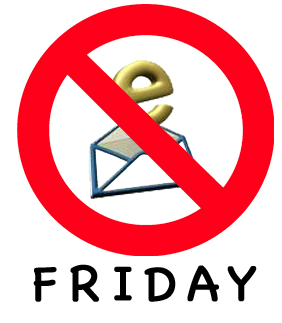
1. Email-free Day: Email has been getting out of hand for me lately. From wasted time on CYA activities (noted in an earlier blog) to the mass of incoming and outgoing messages I deal with everyday it is all a bit overwhelming.  I checked my sent items this morning and quickly determined that in the past two weeks I have sent 422 messages.

I decided today would be different.

My goal? Zero sent messages.

http://rivera-pr.com/blog/wp-content/uploads/2008/11/no_email_friday.jpg

9 hours later…mission accomplished!

I will admit three times I caught myself pecking out a reply to someone but each time I quickly caught myself and either made a return call or just walked over to their desk instead.

As a result, I learned a simple lesson. You talk to a hell of a lot more people in a day when you commit to sending less email. Presumably this is a good thing. This trial showed me email-free days could be worthy of a bit more experimentation.  Finding a way to stop reading them for a day might be next.

2. Overtime solves nothing: When I chair a meeting it starts on time. People know this, so they quickly adjust and show up on time.  Very rarely do I allow my meetings to go over the scheduled time slot too, and certainly not without checking on the participants to see if it is both ok and agreed it will be worth it.

After participating in two meetings today that both started and ended late it occurred to me extra time at the end rarely solves anything. Whether you start on time or not, if you haven’t solved the problem by the scheduled end, rarely is another 15 minutes going to solve anything. Often it is better to move on and then, only if necessary, revisit later when everyone can come in fresh.

Lying to your kids and a Kodak Moment

Today I learned:

1. Don’t lie to your kids: If you accidently break one of your daughter’s toys you need to own up to it. The other natural alternative – telling her it was destroyed by the wolves in the backyard who ate it when it was left out last night – is just a story full of holes that will be picked apart by your highly analytical child at roughly 3:17 am.

2. A Kodak Moment: On the drive to work I listened to an article from the Economist contrasting Kodak’s failed attempt to transition its brand from a dying industry, with that of rival firm Fuji-film which has successfully altered its course, surprisingly, towards a position within the cosmetic industry (among other ventures).

At lunch I found another Kodak article, this time by Seth Godin, that addresses the difficulty successful incumbents have in identifying a new course – my favourite quote being Kodak was “so in love with their success that they insisted the world change in their favor, as opposed to embracing the future that was sure to arrive.”

The lifecycle concept applies to every company in every business and (simplistically speaking at least) only the speed of transition for the industry really differs. Despite that, it is amazing to see how many companies live in the present rather than planning for tomorrow.  Personally, it certainly made me think about what percentage of my day I spend in the present and what percent I spend planning for the future. I decided to setup a simple reminder – a bit of “Kodak Time” is now scheduled into my monthly calendar.

As a aside, a special message to the strategists at Kodak:

Dear Kodak,

Digital printing will not save you guys, either.  It might not even be viable by the time you get good at it.

Sincerely,

Logic.